

Dutch Oven Sourdough Bread
Is it really possible to get crispy-crusty, chewy and tangy, bakery-style sourdough at home? It is with this Dutch oven sourdough bread recipe! I’ve been baking bread for 17 years and I’ll show you how to nail the perfect loaf, and why a Dutch oven is key to getting that divine golden crust.
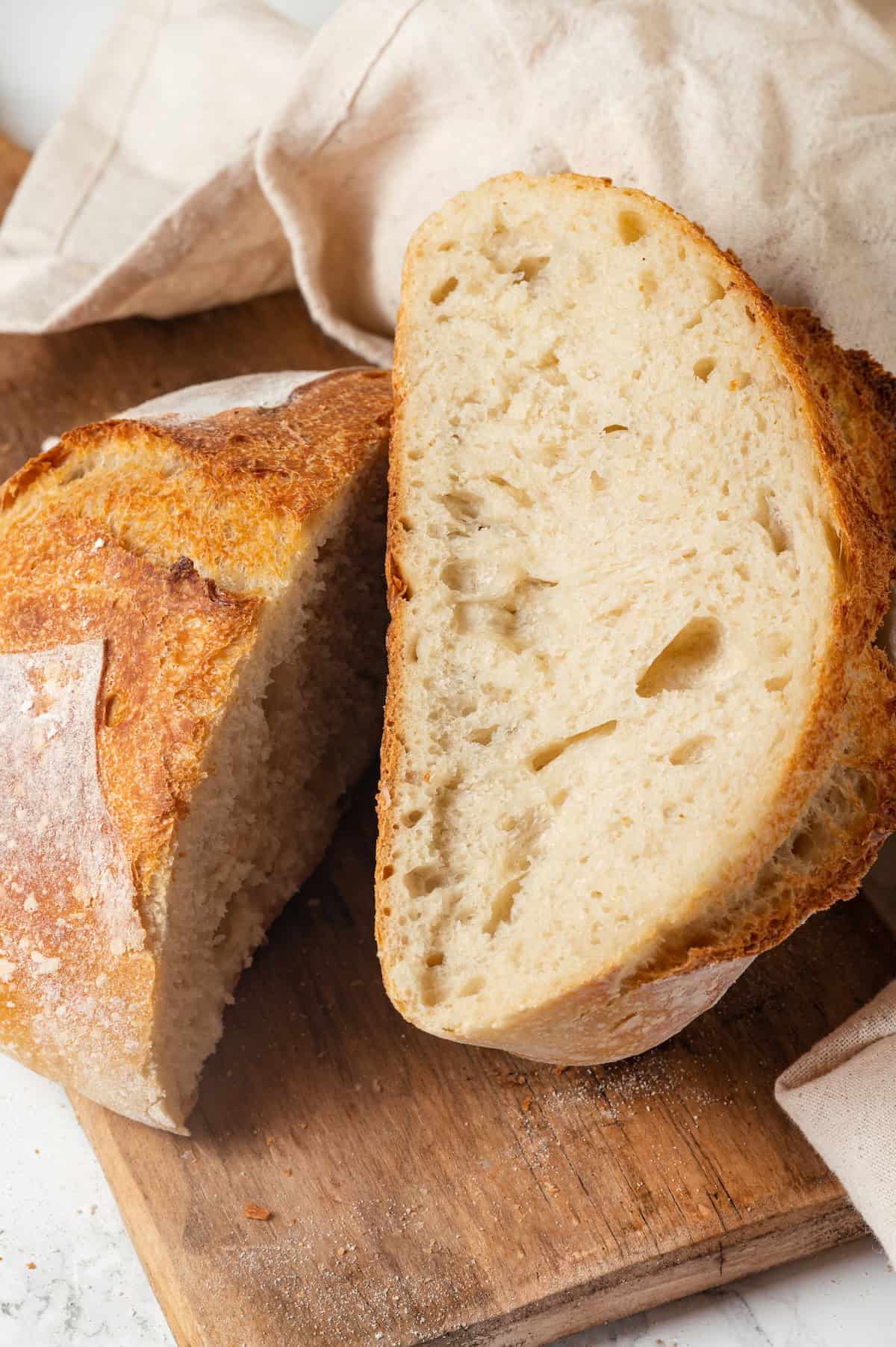
You shape your sourdough loaf, you set it on a sheet pan, you pop it in the oven, and it’s good, but the crust just isn’t right. Has this happened to you? Because oof, I’ve been there, friends (trust me, I remember my first sourdough loaf!). But then I discovered the secret to bakery-style sourdough at home: you need a Dutch oven. The Dutch oven is the best stand-in for a bakery oven, creating steam that helps the bread rise and develop that signature golden, crackly-crisp crust. (PS – It’s the secret to my Dutch oven bread recipe too, which is perfect if you don’t have sourdough starter.)
3 Things You Can Expect from This Dutch Oven Sourdough Bread
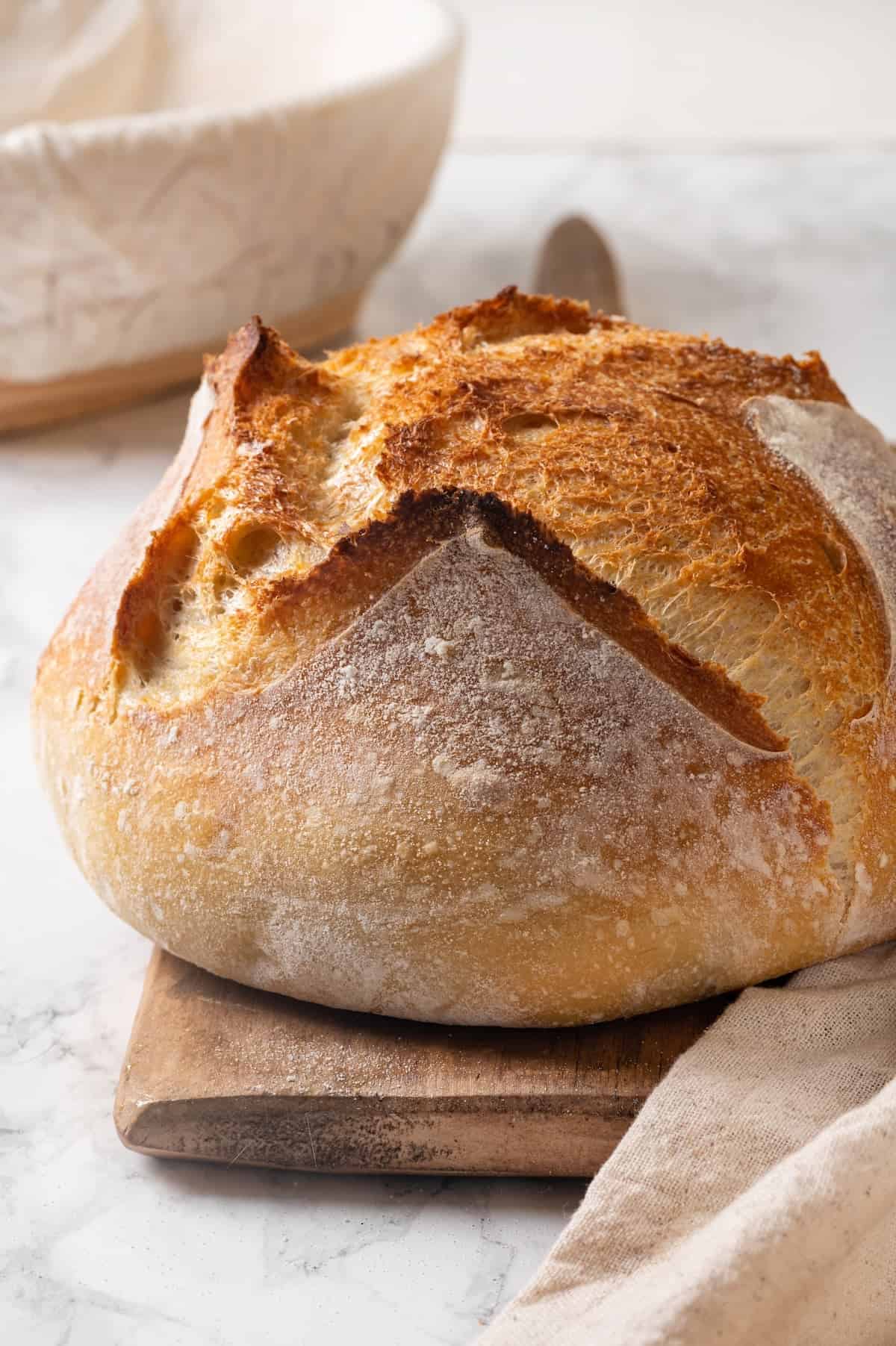
- Crispy artisan crust. As we’ve discussed, baking in a Dutch oven creates that classic crackly exterior. Baking covered first traps steam inside the pot, which helps the loaf rise well and gives the crust a better texture.
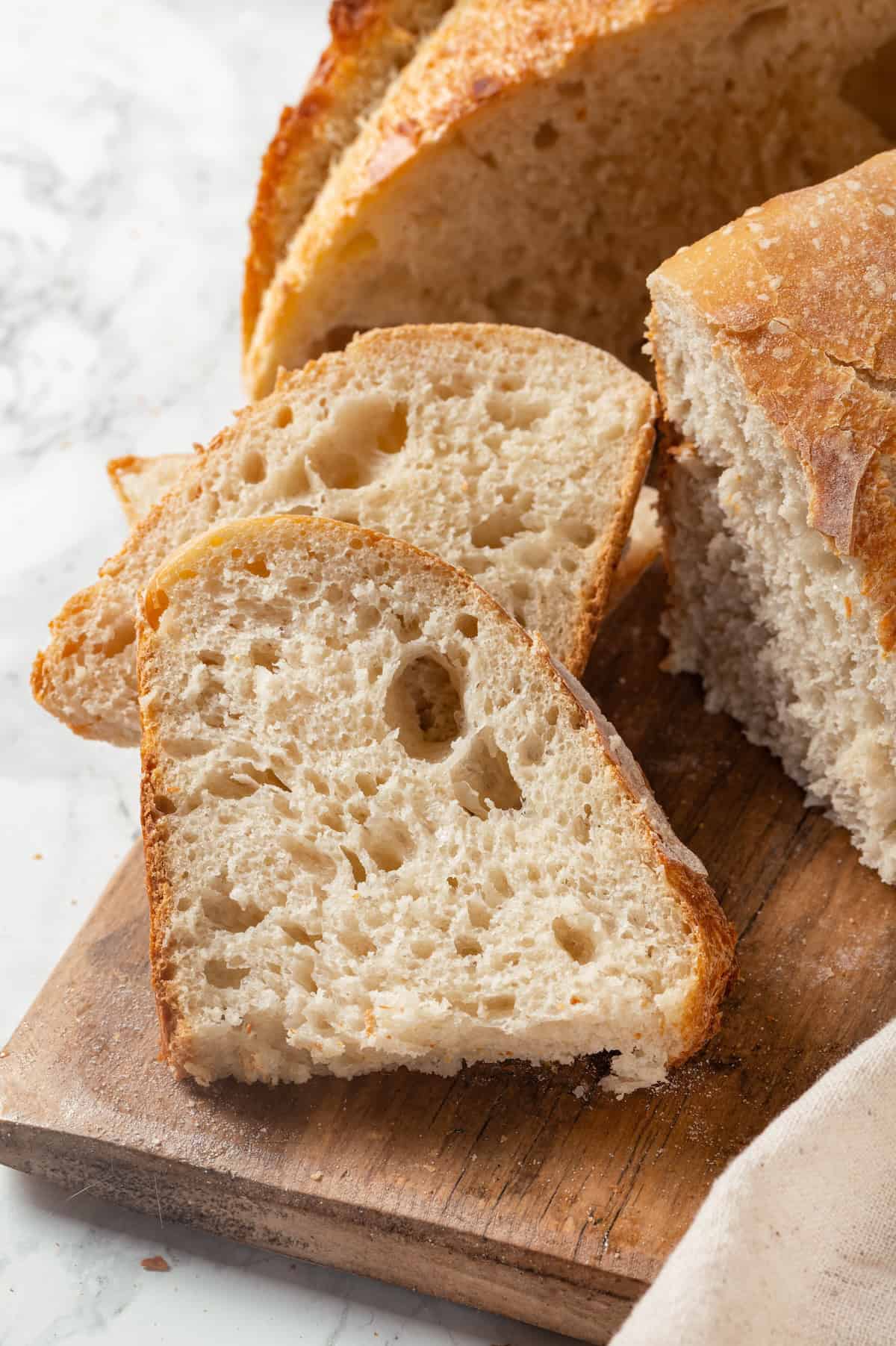
- Soft, chewy interior. The long fermentation gives the bread its airy texture and a fantastic chew (without being too chewy).
- Deep, developed flavour. The overnight rest builds that signature sourdough tang.
Notes on Ingredients
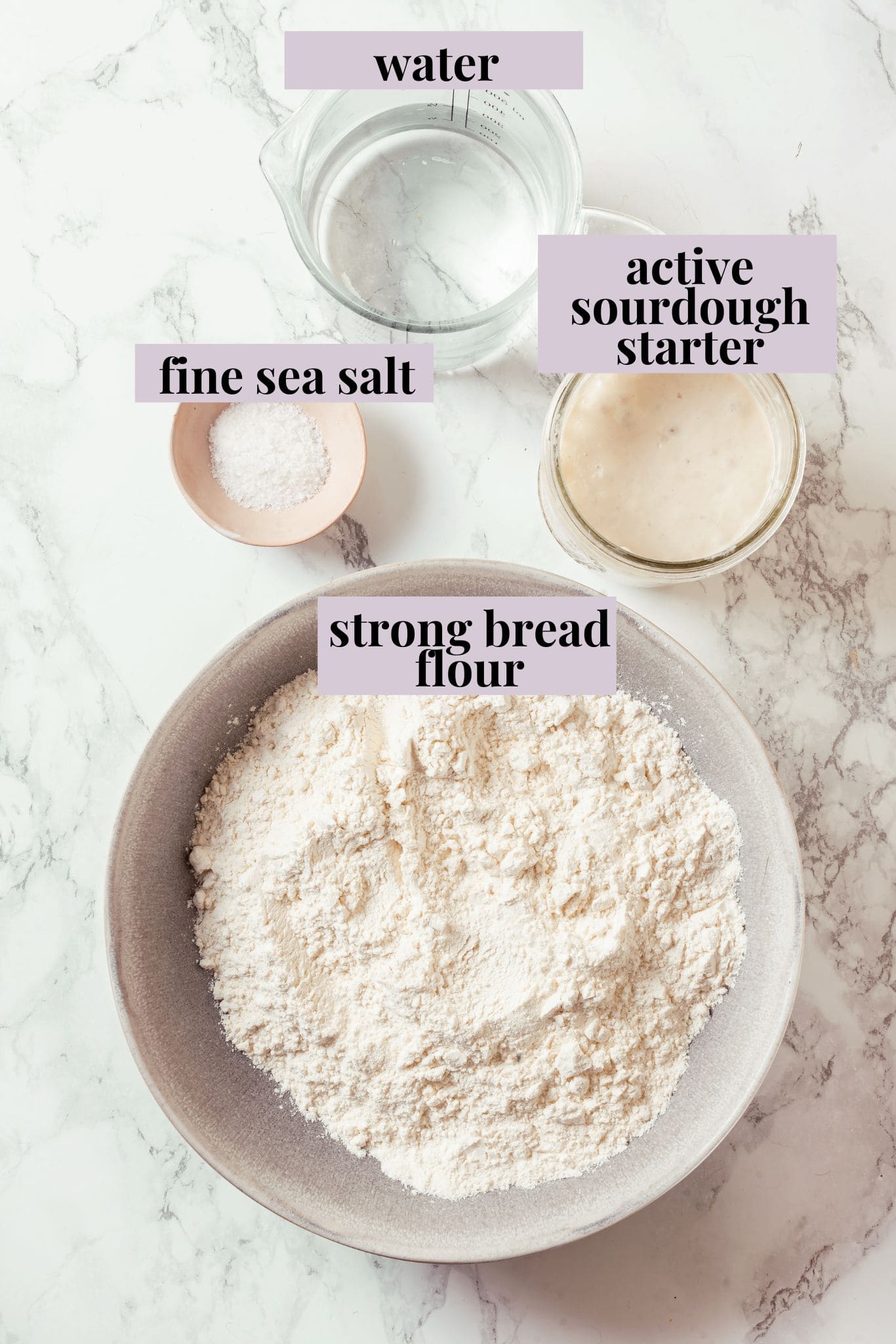
Here’s what you’ll need to make this sourdough bread. Scroll down to the recipe card for exact measurements and full instructions.
- Water – For hydration.
- Sourdough starter – Make sure it’s active and bubbly for the best rise.
- Bread flour – A high-gluten flour gives the loaf structure and chew. I’ve tested this with All Purpose Flour and while it still came out okay, the bread flour was leagues ahead so I highly recommend using this only.
- Salt – There’s no sodium elsewhere in the recipe, so the salt is quite important!
How to Make Sourdough Bread in a Dutch Oven
Below you’ll find step-by-step photos showing the process of making this sourdough bread, but the full instructions are in the recipe card at the bottom of the post.
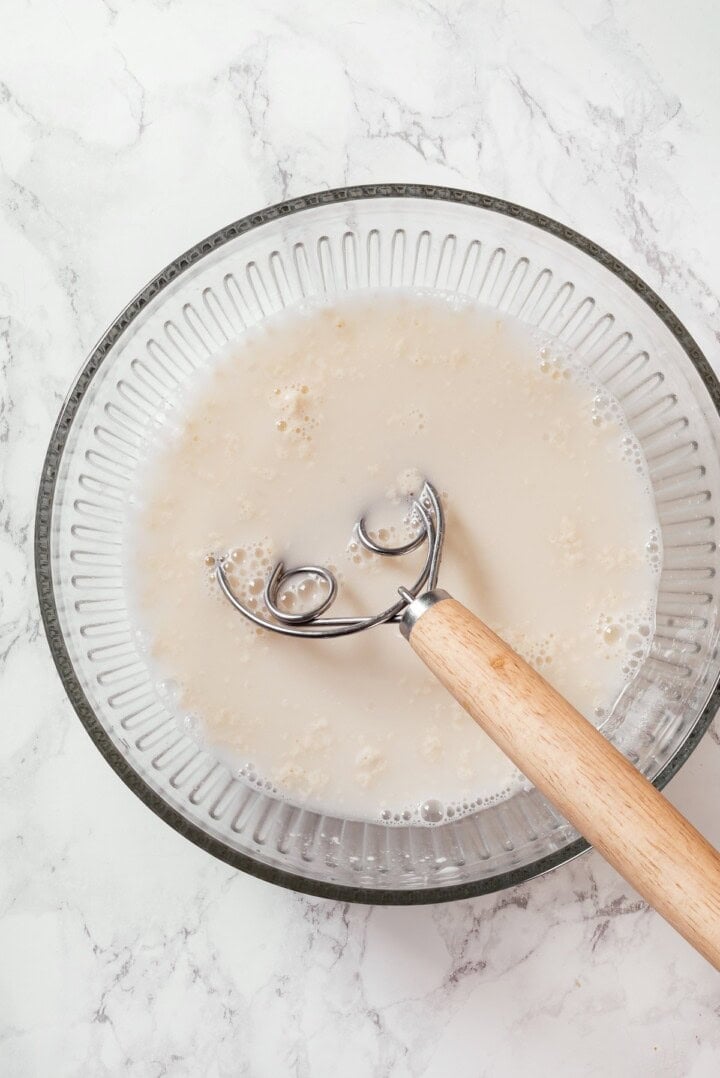
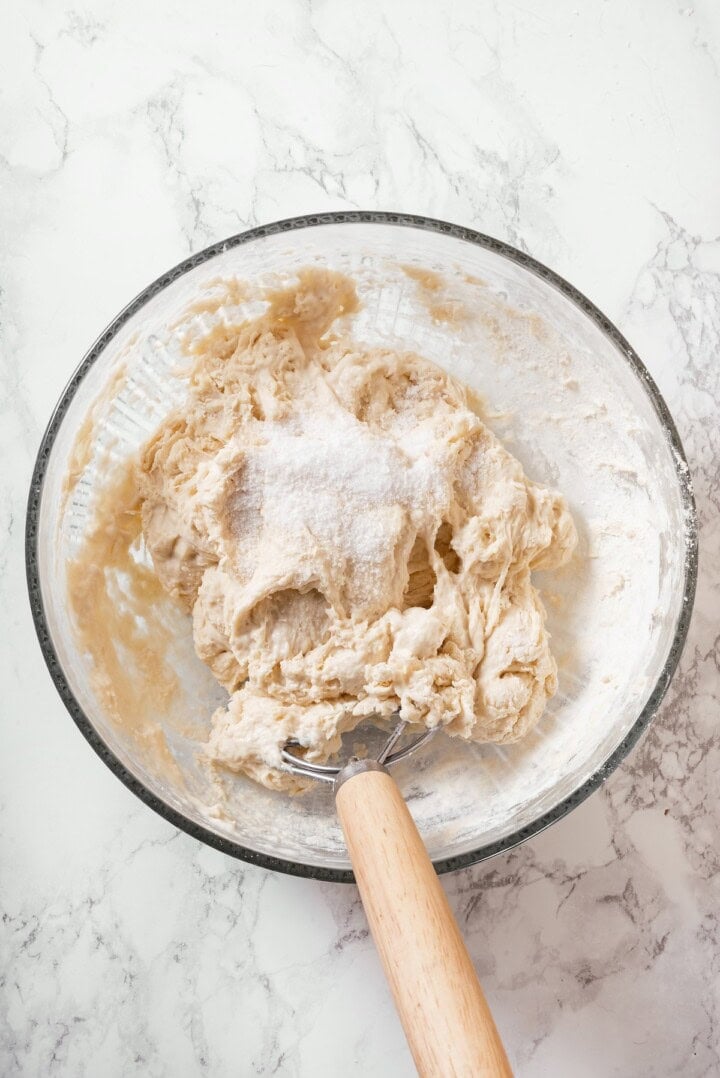
- Mix the dough. Stir together the water and sourdough starter until combined, then add the flour and mix into a rough dough. Sprinkle in the salt and mix again until everything is incorporated.
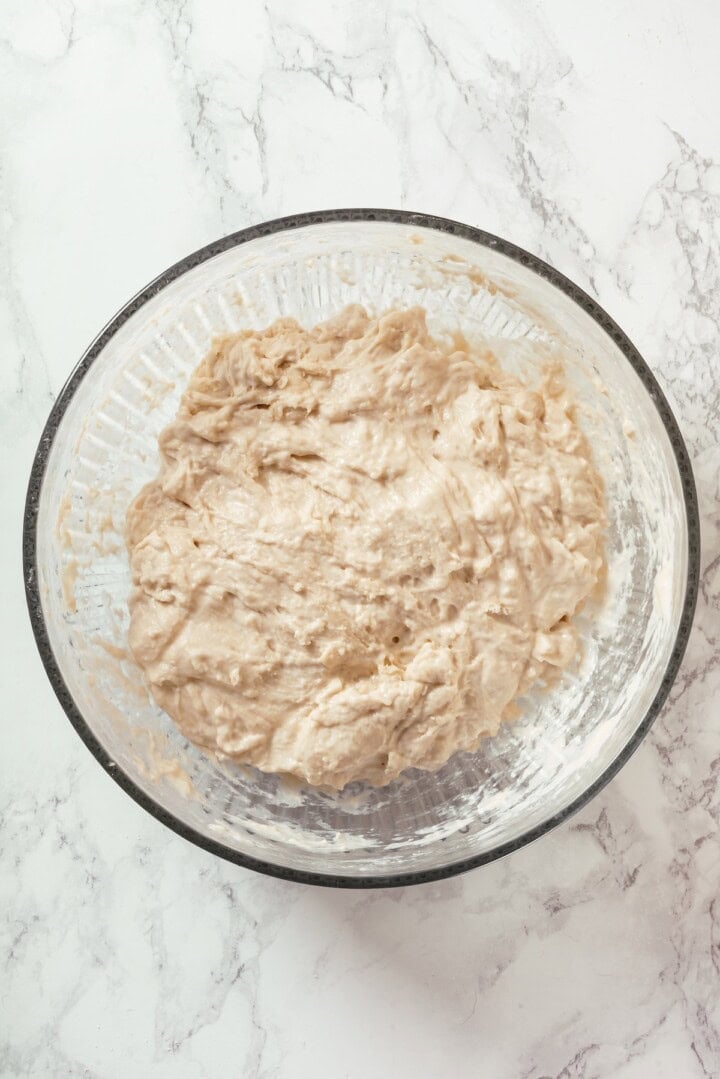
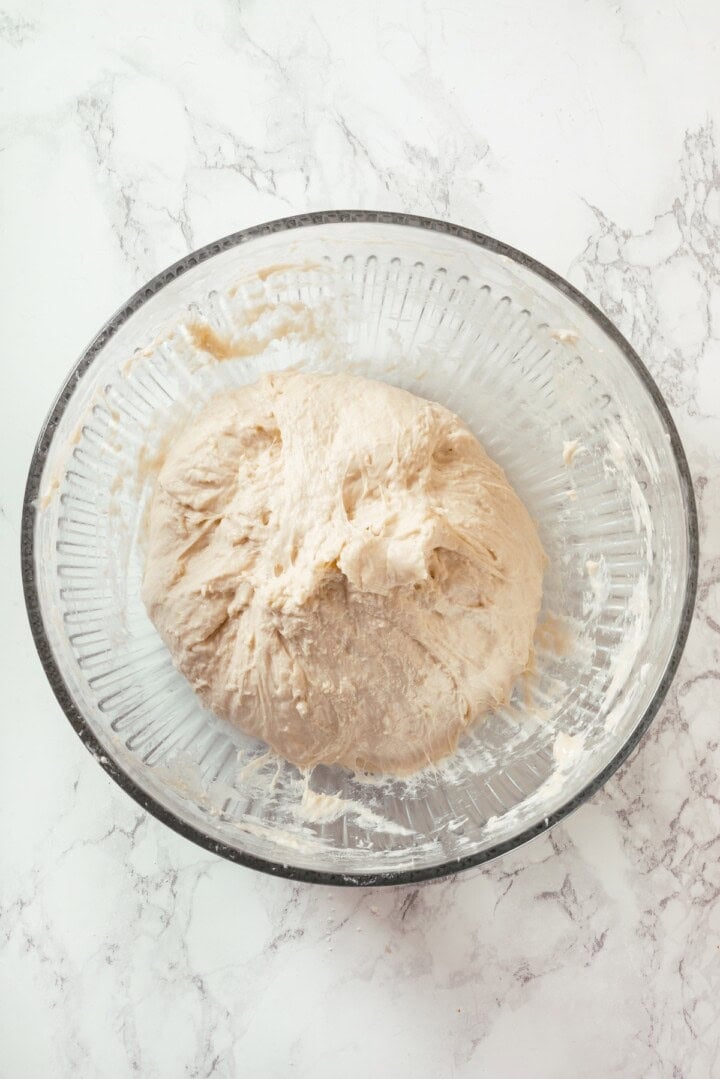
- Rest the dough. Cover and let the dough sit so the flour hydrates and the gluten begins to develop.
- Stretch and fold. With damp hands, stretch one side of the dough up and fold it over itself. Rotate the bowl and repeat on all sides, then let the dough rest. Repeat this process one more time.
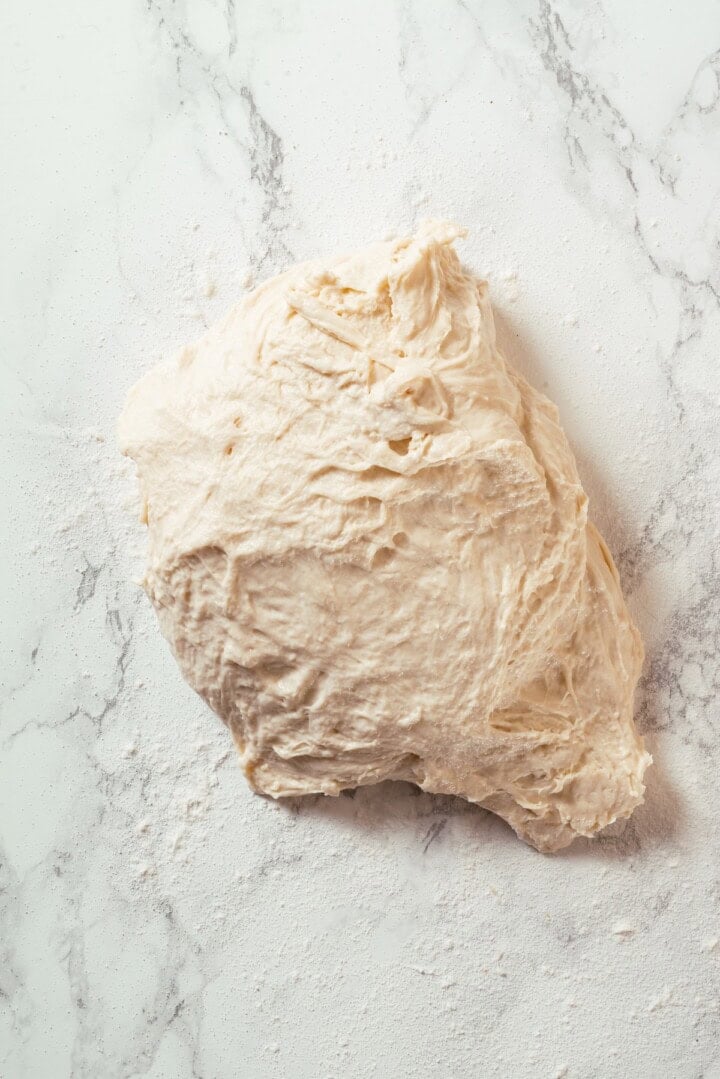
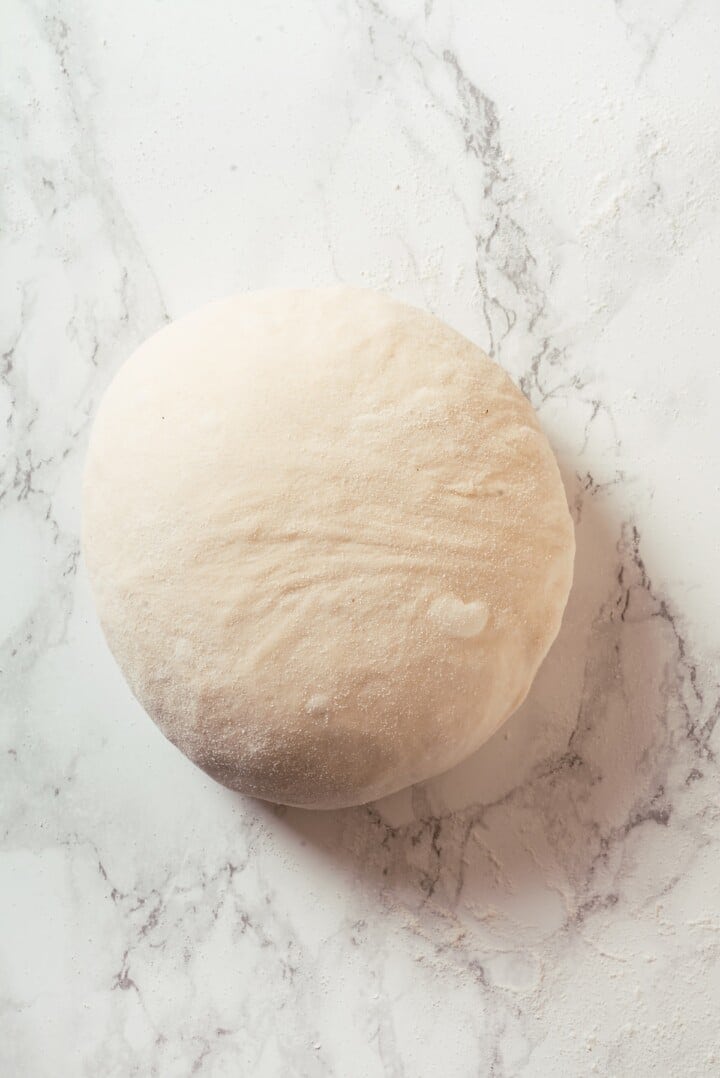
- Shape. Turn the dough onto a floured surface and gently shape it into a round, tightening the surface as you go.
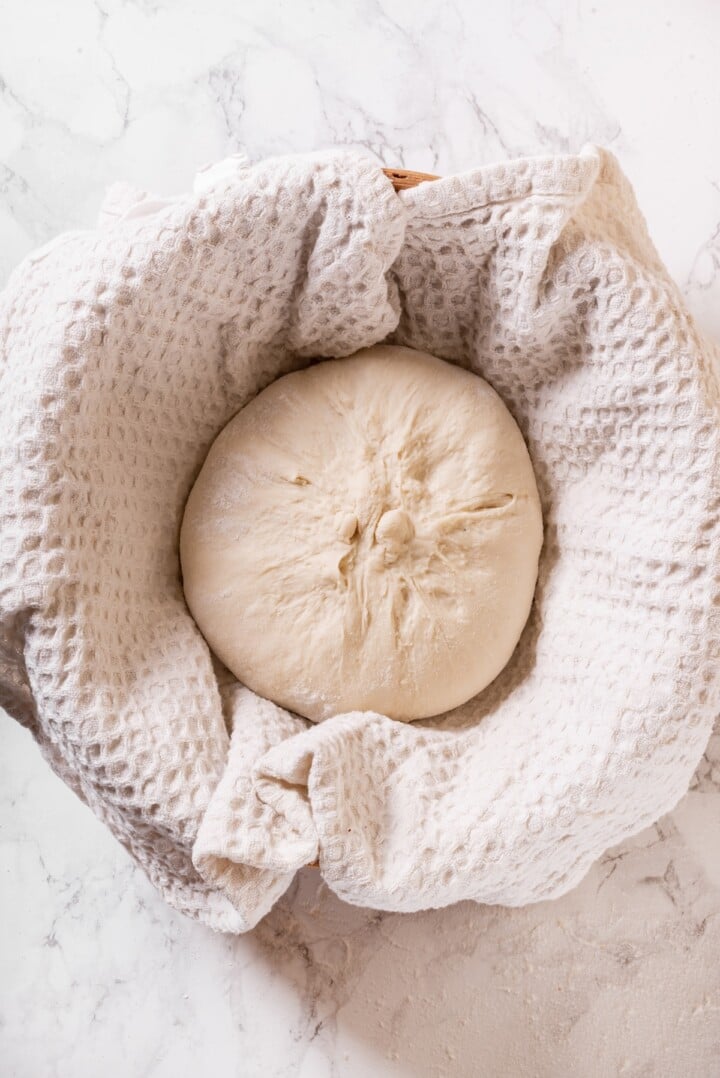
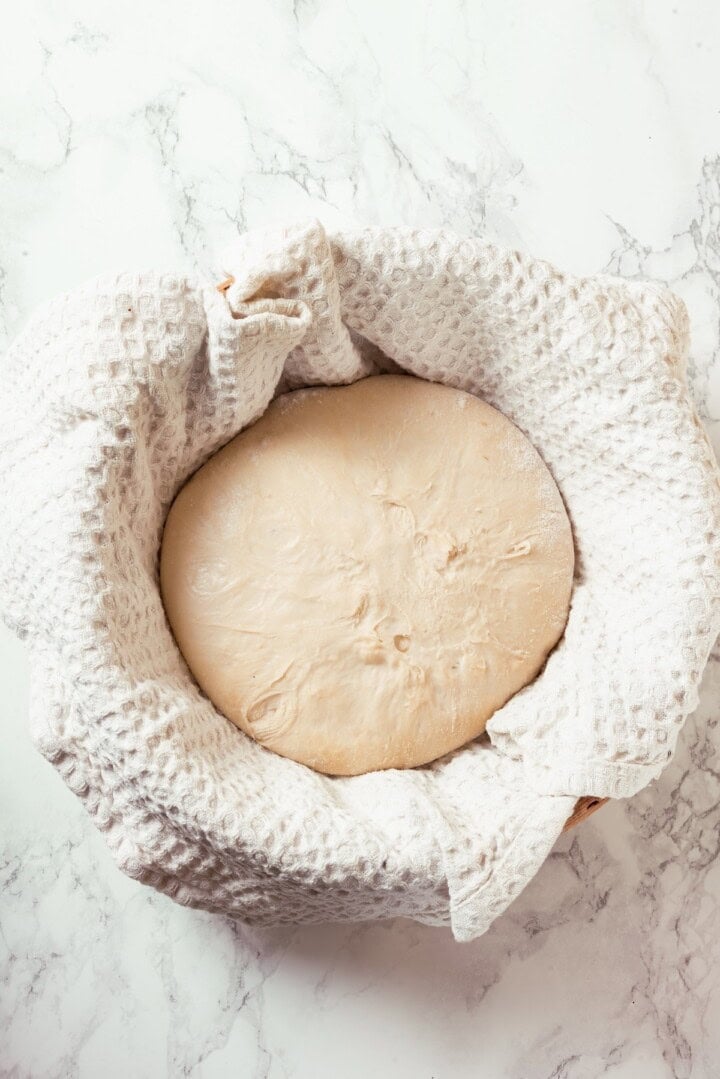
- Cold proof. Transfer the dough to a floured bowl or proofing basket, cover, and refrigerate overnight so it slowly ferments and develops flavour.
- Preheat the oven. Place a Dutch oven in the oven and preheat until very hot.
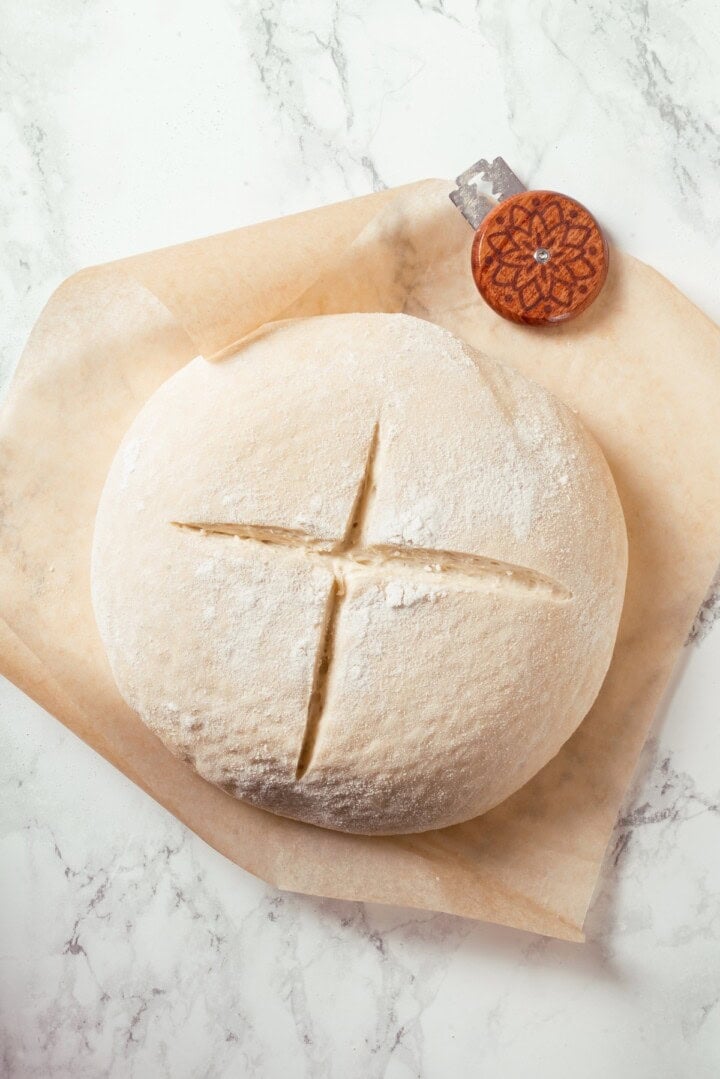
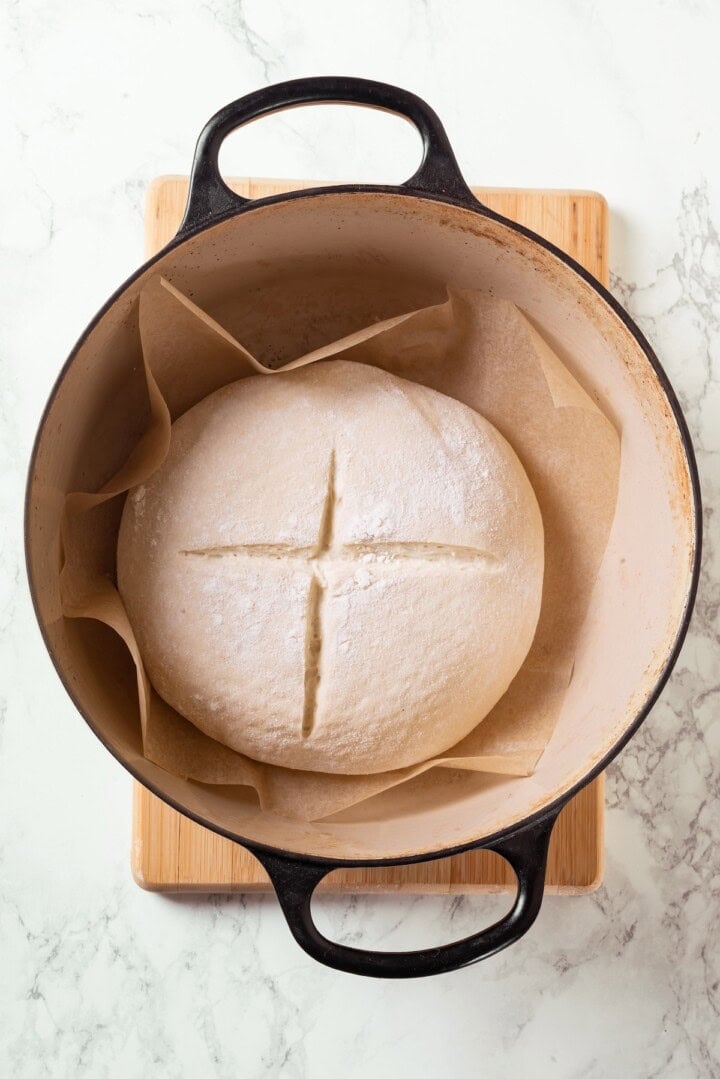
- Score and bake. Turn the cold dough onto parchment, score the top, and carefully transfer it into the hot Dutch oven. Cover and bake to allow the loaf to rise.
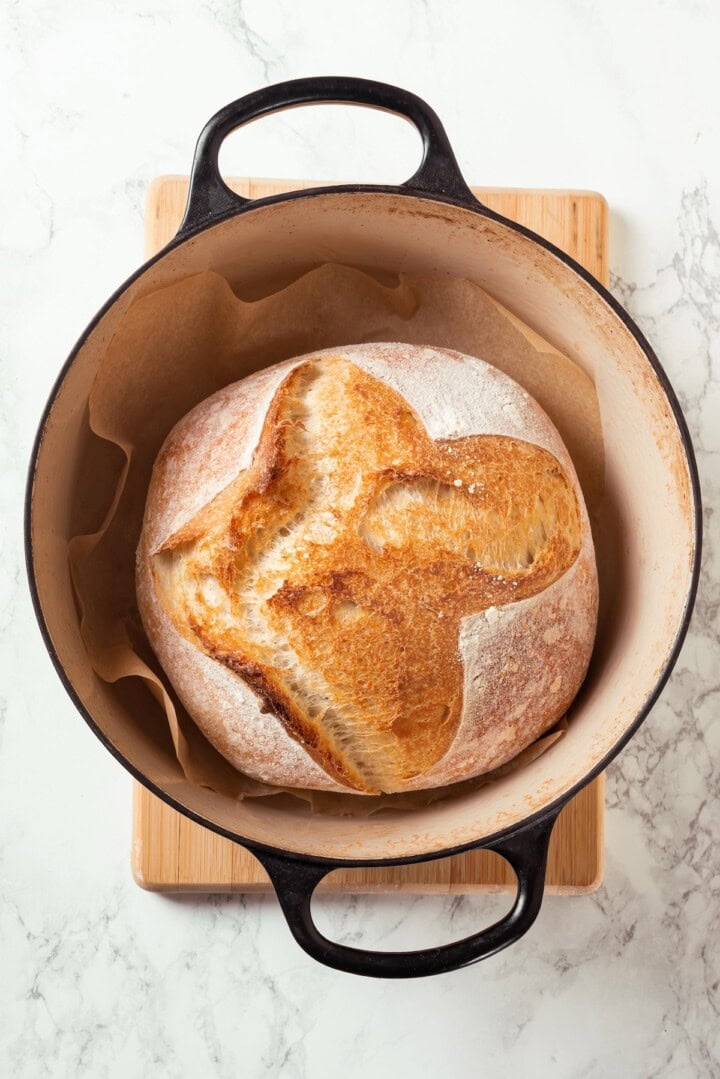
- Finish baking. Remove the lid and continue baking until the crust is deeply golden and crisp.
- Cool. Let the bread cool completely on a rack before slicing so the interior sets properly.
Tips for Baking Sourdough Bread
These pointers are important for any sourdough recipe, whether you’re making this Dutch oven sourdough bread or another loaf.
- Use bread flour. It’s really not the same as all-purpose flour; it has more protein (gluten), which is important for any yeast bread.
- Make sure your starter is active. Although it depends on the temperature of your kitchen and the condition of your starter, this is generally 4 to 8 hours after you feed it, when it has doubled or tripled in volume. I also want to say; if your starter is only 2 weeks old (or less!) and is doubling or tripling, I still recommend waiting even one more week to ensure it’s strong enough to use! As your starter matures, you’ll continue to see increasingly better results.
- Go by weight, not volume. Although I do provide volume measurements, using grams is much better when baking bread, as precision is key.
- Use wet hands to incorporate the salt if you’d like. I didn’t use hands for mixing in the salt, but you can use wet hands if you’d like. Sprinkle the salt over the dough, and pinch, fold, and massage it in with wet fingers.
- Don’t refrigerate the dough too long. While 18 to 24 hours in the fridge is usually still fine, over 24 hours and the dough will over-ferment, the structure will weaken, and the flavor will be more sour.
Can I Add Mix-Ins?
Want to add some mix-ins to your Dutch oven sourdough bread? You can! Just make sure anything you add is no more than 60 to 80 grams total.
- For items where you want an even distribution (like vegan cheese, herbs or olives), add them during the second stretch and fold. My current favourite combination is vegan cheese, scallions, and a little bit of roasted garlic. If you are using sun-dried tomatoes, please dry them off completely since all the excess oil will pool and ruin your loaf!
- For something where you want a layered or swirled effect (like cinnamon sugar, pesto, or chocolate), add during shaping, in the center as you fold.
A Note About Bulk Fermentation
Wondering where the bulk fermentation is in this recipe? Here, we have about an hour and a half at room temperature, followed by a cold proof for 12 to 18 hours. What this means is that bulk fermentation is happening mostly in the fridge; it’s a cold-first fermentation style.
The dough will not visibly rise in the fridge, which is intentional. It will be smoother, a little puffier, and the elasticity will increase slightly. It won’t double, get bubbly, or have a dramatic rise.
Troubleshooting
Here are the main reasons people have issues with baking sourdough bread and how to prevent them:
- Weak starter. Signs are a dense loaf, little oven spring, and tight crumb.
- Fix: Starter should double in 4–6 hours before using.
- Under-fermentation. Signs are tight crumb, pale crust, and no rise.
- Fix: Extend the room temperature time before refrigerating by 1 to 2 hours.
- Over-fermentation. Signs are dough spreading flat, a sour smell, and sticky, slack dough.
- Fix: Shorten the cold proof.
- Poor shaping. Signs are that the bread spreads instead of rising.
- Fix: Make sure the dough feels taut after shaping it into a boule.
- Not scoring properly. Signs are a loaf that doesn’t expand or bursts randomly.
- Fix: Score between 1/4- and 1/2-inch deep.
Storage
- Room temperature: Store sourdough bread in a bread bag or wrapped loosely for up to 3 days.
- Freezer: Slice and freeze in a freezer bag for up to 2 months. Thaw at room temperature to serve.
More Homemade Bread Recipes
Enjoy friends! If you make this Dutch oven sourdough bread, please snap a photo and tag #jessicainthekitchen on Instagram! We’d also love it if you would leave a comment below, and give the recipe a rating! Thanks so much!

Dutch Oven Sourdough Bread
Ingredients
- 1¼ cups water, 280g
- ½ cup active sourdough starter, 100g
- 3 ⅓ cups strong bread flour, 420g
- 1 ¾ teaspoons fine sea salt, 10g
Instructions
Make the dough:
- In a large bowl combine the water and sourdough starter. Stir until the starter dissolves.
- Add the strong bread flour and mix until a shaggy dough forms and no dry flour remains.
- Sprinkle the salt over the dough and mix again until fully incorporated.
- Cover the bowl and let the dough rest for 30 minutes at room temperature. This allows the flour to hydrate and begins gluten development.
First stretch and fold:
- With slightly wet hands, grab one side of the dough, stretch it upward about 6-8 inches (15-20 centimeters), and fold it over the center. You can also use a plastic dough scraper for this. Rotate the bowl and repeat until all four sides are folded.
- Cover and rest for 30 minutes.
Second stretch and fold:
- Repeat the same stretch-and-fold process.
- Cover and rest for 30 minutes.
- If you have any inclusions (vegan cheese, scallions, etc) you can add them here (ensuring you add is no more than 60 to 80 grams total).
Shape the loaf:
- Lightly flour the counter and turn out the dough. Gently flatten it slightly, then fold the edges toward the center to form a round. Flip it seam-side down and tighten the surface by gently pulling the dough toward you across the counter a few times.
- The dough should form a smooth, slightly tight ball. You'll know it's ready when you gently touch the top and it springs back quickly and there are a few little bubbles on top.
Cold proof:
- Place the dough seam-side up into a lightly floured bowl or proofing basket. I like to stitch any pieces together but it isn't necessary.
- Cover well and refrigerate for 12-18 hours. The dough will slowly ferment and develop flavor.
Bake:
- Place a Dutch oven (4 quart/24 centimetres) with lid into the oven and preheat to 450ºF (230ºC) for 45-60 minutes.
- Turn the cold dough onto parchment paper seam-side down. Give it a nice deep store on the top with a sharp blade. Carefully transfer the dough into the hot Dutch oven.
- Cover with the lid and bake for 30 minutes.
- Lower the temperature to 375ºF (190ºC). Remove the lid and bake for another 15 minutes until the crust becomes deep golden brown.
- Transfer the bread to a rack and let it cool at least 1 hour before slicing.
Notes
- Use bread flour. It has more protein (gluten), which is important for any yeast bread.
- Notes on the starter. Wake up your started (by feeding it) and let it sit for ~4-8 hours before using. I also encourage you to use a mature started (at least 3 weeks old) for the best results.
- Weigh your ingredients. Using grams is much better when baking bread, as precision is key.
- Don’t refrigerate too long. Chilling the dough for more than 24 hours will cause it to over-ferment for a weaker structure and and an overly sour flavour.
- Size expectations. Finished loaf is a small-to-medium artisan boule, roughly 7-8 inches wide and 3-4 inches tall.
- Storage. Store sourdough bread in a bread bag for up to 3 days on the counter or slice the bread, transfer it to a freezer bag, and store for up to 2 months in the freezer. Thaw at room temperature.
Disclaimer: Although jessicainthekitchen.com attempts to provide accurate nutritional information, kindly note that these are only estimates. Nutritional information may be affected based on the product type, the brand that was purchased, and in other unforeseeable ways. Jessicainthekitchen.com will not be held liable for any loss or damage resulting for your reliance on nutritional information. If you need to follow a specific caloric regimen, please consult your doctor first.



Greetings Jessica from Sherman Oaks, California. I am beyond amazed at your Sourdough recipe, and these questions are from me and my baking bestie, Denise. Can’t tell you how your response will seal the deal for us. In the initial mix, after shaggy is achieved, you sprinkle the salt and continue to mix again…are we trying to keep the shaggy texture, or to incorporate the salt throughout, do you form more of a dough? Secondly, I am stunned to learn that you can do only 2 stretch/folds within the first hour and a half of creating the dough…then shape, put into my banneton, and do the entire bulk ferment in the fridge. I’ve read your recipe many times so I wouldn’t have to appear silly in asking….but here I am :). Lastly, can I use my strong starter right from the fridge? Your loaf is stunningly beautiful. Thank you so much for sharing.
Hi Jeff,
Thank you so much for your comment!! I hope you and Denise enjoy this recipe SO so much!! Of course, as you’re incorporating the salt it’s totally okay for the texture to change a little bit to more of a cohesive dough. It shouldn’t take more than like, 1 minute, to fully incorporate it. Feel free to use damp fingers to pinch and incorporate it, too!
Re the stretch and folds – yes we found that only 2 works here thanks to the fridge bulk fermentation! For the record, you don’t sound silly in your questions at ALL! They are great questions and I always appreciate them because I actually love expounding! I’ve done a couple teaching stints in my life and it really is one of my favourite things to do plus I always learn from you too! I bet Sherman Oaks is gorgeous!!
Re strong starter – I recommend removing it from the fridge, feeding it, letting it double or triple in 4-6/8 hours, and then making your bread so that you know it is at its peak and ready to bake! I hope this helps SO much and that you enjoy so so much!! If you have any other questions, please let me know!
Amazing worked perfectly! We’ll be making this over and over again.
Thank you so much for sharing Todd!! SO happy to hear this!!
You said for a stronger dough to feed it. How do you do that? with just the water and yeast then add some flour in a liquid form ?
I buy from the local bakery. They put jalapeño & cheddar cheese in it.
They only make it once a week. I can never get it as it’s all sold out, it’s great for avocado toast.
Hi Robin,
You’ll feed it according to the recipe or ratios you have been using for your sourdough starter! This will make it nice and strong for the recipe. Excited for you to give it a whirl with the jalapeño and cheddar!
Looks great , but don’t know how to make a starter; can you please, share a good easy, not too complicated starter recipe?
Hi Rina!
Thanks so much! We don’t have a sourdough starter recipe on the site just yet, but there are lots of great beginner-friendly starter tutorials online with step-by-step instructions. I’d recommend choosing one with good reviews and sticking with it all the way through, since different methods can vary a little.
Once you have your starter going, you’ll be all set to make this bread. Happy baking!
Hi Jessica,
2 questions. I have a 3 1/2 qt Dutch oven. Will that be large enough for the bread, or is the 4 qt non-negotiable?
And 2, can I do a free-form boule on a pizza stone if I toss a cup of water underneath (in a pan, of course)? Thanks so much!!!
Hi Molly!
I’d be hesitant to use one that may be too small, as it may end up expanding to the lid and ruining your loaf. It definitely needs space to rise! We also haven’t tested baking this loaf free-form on a pizza stone with a separate pan of water, so I wouldn’t want to steer you wrong there either. The Dutch oven helps create the steamy environment the loaf needs while it bakes, so for the most reliable result, I’d recommend sticking as closely as possible to the method and equipment listed in the recipe. I hope that helps!