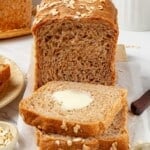
Whole Grain Sandwich Bread
Looking for the perfect slice to build your PB&J or avocado toast on? This whole grain sandwich bread is for you. Soft, tender, and surprisingly easy to make, it sure beats the store-bought stuff!
Ingredients
- 2¼ cups warm water 560ml
- 1½ tablespoons sugar 20g
- 2¼ teaspoons active dry yeast 8g
- 5½ –6 cups whole wheat flour 650g–700g
- 1½ teaspoons fine sea salt 8g
- 3 tablespoons olive oil 40g
- ½ cup rolled oats for topping, 40g
Instructions
Make the Dough
- Activate the Yeast. In a large mixing bowl, combine the warm water, sugar, and yeast. Stir gently and let sit for 5–10 minutes, until the mixture becomes foamy. If little or no foam appears, the yeast is no longer active and should be replaced.
- Mix the Dough. Add the whole wheat flour, salt, and olive oil. Stir with a wooden spoon or mix on low speed with a stand mixer until a rough, shaggy dough forms. If the dough looks overly wet, add a little more flour.
- Knead the Dough. Transfer the dough to a lightly floured surface or continue kneading with the dough hook. Knead for 8–10 minutes by hand or 6–7 minutes in a stand mixer, until the dough is smooth, elastic, and slightly tacky.Whole wheat flour absorbs water more slowly than white flour, so give the dough plenty of kneading time before adding extra flour. A slightly tacky dough will produce the softest loaf.
Let it Rise
- First Rise. Lightly oil a large bowl and place the dough inside, turning once to coat. Cover with a clean kitchen towel or plastic wrap and let rise in a warm, draft-free place for 1–1½ hours, or until doubled in size.
- Shape the Loaves. Lightly grease two 8×4-inch loaf pans.Turn the dough onto a lightly floured surface and divide it evenly in half. Press one piece into a rectangle about the width of your loaf pan. Starting from the short side, roll the dough tightly into a log, pressing gently as you roll to remove large air pockets. Pinch the seam closed, tuck the ends underneath if needed, and place seam-side down in the prepared pan. Repeat with the remaining dough.
- Second Rise. Cover the pans loosely with a kitchen towel and let the loaves rise for 30–60 minutes, or until the dough rises just above the rims of the pans. When lightly pressed with a fingertip, the dough should slowly spring back.
Bake
- Preheat. Preheat the oven to 375°F (190°C).
- Add the Oats. Lightly brush the tops of the loaves with water and sprinkle evenly with the rolled oats, gently pressing them into the surface.
- Bake. Bake for 35–40 minutes, until the loaves are deep golden brown and sound hollow when tapped. For the most accurate test, the centre of the bread should reach 190–200°F (88–93°C).If the tops begin browning too quickly, loosely tent them with foil during the final 10–15 minutes of baking.
- Cool. Let the loaves cool in the pans for 10–15 minutes before transferring them to a wire rack. Cool completely before slicing to prevent a gummy texture.
Notes
- Activate that yeast. Make sure the water is 105–110°F (40–43°C) and watch for a foamy film to form. If it doesn't, you need new yeast.
- Add flour with care. You can add more flour if the dough is too sticky to work with, but knead it thoroughly before you make the call. Too much flour will end you with an over-dense loaf.
- Log trick. Rolling the dough into a log before placing it in the pan will help create a more even sandwich-style crumb.
- Use a thermometer. Not just the timer. You'll know your bread is done when the centre reaches 190–200°F (88–93°C).
- Cool completely. Let the bread cool all the way before slicing to avoid a gummy texture.
- Storage. Seal the bread in an airtight container and store it at room temperature for up to 4 days. Otherwise, wrap tightly in a double layer of plastic wrap and store it in the freezer for up to 3 months. Thaw on the counter before diving back in.
Nutrition
Serving: 1slice | Calories: 95kcal | Carbohydrates: 17g | Protein: 3g | Fat: 2g | Saturated Fat: 0.3g | Polyunsaturated Fat: 0.4g | Monounsaturated Fat: 1g | Sodium: 118mg | Potassium: 87mg | Fiber: 3g | Sugar: 1g | Vitamin A: 2IU | Vitamin C: 0.001mg | Calcium: 9mg | Iron: 1mg